Showing posts with label IndiaTech. Show all posts

Sunday, April 19, 2026

Are Indian CX Leaders Really Ready for AI-Led Enforcement?

Are Indian CX Leaders Really Ready for AI-Led Enforcement? | Rinoo Rajesh
Blog • CX • AI • Digital Transformation

Are Indian CX Leaders Really Ready for AI-Led Enforcement?

Author: Rinoo Rajesh Published: 19 Apr 2026 Reading time: ~5 mins

A lot of organizations say they are “doing AI in CX.” I hear it in boardrooms, industry panels, and vendor decks almost every week. But let me be blunt: in many cases, what they call AI transformation is still little more than a chatbot, a summarizer, or a shiny copilot writing nicer emails.

That is not AI-led enforcement.

AI-led enforcement begins when AI stops being merely assistive and starts influencing outcomes: routing customers, flagging risk, nudging agents, enforcing quality thresholds, and increasingly, supporting compliance decisions in real time. That shift is already underway.

The interesting part is not that enterprises are piloting AI. Almost everyone seems to be doing that now. The real question is whether they are operationalizing AI with intent. That is where the gap lies. And frankly, that is where the next wave of winners will emerge.

Why This Moment Feels Different

India is unusually well placed for this next phase. We already live inside one of the world’s most demanding digital ecosystems. Customers here are used to speed. They are used to convenience. And they are increasingly unforgiving when service feels slow, repetitive, or disconnected.

That shift in expectation matters. Customers no longer compare your service experience only with your competitor’s call center. They compare it with the best digital interaction they had yesterday. A seamless UPI payment. A quick WhatsApp exchange. A delivery app that simply worked without drama.

So when CX leaders ask whether AI is necessary, I think they are asking the wrong question. The real question is this: how else do you deliver speed, precision, scale, and consistency across millions of interactions without some form of intelligent automation and enforcement?

The Problem with Superficial Adoption

One of the biggest mistakes I see in enterprises is this: they measure AI usage instead of AI impact. A team uses a copilot. Someone deploys a chatbot. An email gets drafted faster. A dashboard somewhere shows “AI adoption.” Everyone feels mildly pleased. But the customer experience remains largely unchanged.

That is cosmetic adoption, not transformation.

The real leaders are the ones who step back and ask tougher questions. Where are the friction points in the customer journey? Where are customers being forced to repeat themselves? Where are agents struggling with inconsistency? Where is compliance risk highest? And where can AI intervene not just to automate, but to improve trust, quality, and customer outcomes?

In customer experience, AI is not fundamentally a technology challenge. It is a trust challenge.

Why Trust Is the Core Issue

Customers can forgive a delay more easily than they forgive a machine that sounds confident and gets their problem completely wrong. Enterprises can tolerate experimentation, but they have far less patience for unmanaged compliance, broken journeys, and repeat escalations created by poorly designed automation.

That is why AI-led enforcement must be designed around trust architecture. Not just models. Not just workflows. Trust architecture.

To me, that trust architecture has three layers.

First, customer journey intelligence. You need to understand where the friction actually lives. Not where the vendor deck says it lives.

Second, enforcement intelligence. You need to identify where AI should guide, escalate, intervene, or flag risk.

Third, customer control. Customers need clarity, transparency, and an easy human fallback. Otherwise, even good automation can feel like a trap.

India’s Advantage Is Bigger Than We Think

We often talk as if AI-led CX is something developed elsewhere and imported into India. I think that mindset is outdated. India’s operating reality is already a proving ground for advanced customer experience design. We work at high volumes, across multiple languages, channels, devices, and price sensitivities. That is not a weakness. It is an extraordinary training environment for AI systems that must perform under real complexity.

If Indian CX leaders can combine journey design, intelligent enforcement, and trust-led governance, we do not just catch up. We lead.

So, Are We Ready?

Yes, but only if we stop treating AI as a procurement conversation and start treating it as a leadership responsibility.

Yes, but only if we move from “Where can I deploy AI?” to “Where should AI intervene to improve outcomes, trust, and accountability?”

And yes, but only if we resist the temptation to confuse activity with transformation.

The opportunity is real. The infrastructure is real. The customer need is real. The only remaining question is whether leadership intent will be equally real.

Let’s Continue the Conversation

If this is a conversation you are actively navigating in your organization, let’s connect.

Website: www.rinoorajesh.com
LinkedIn: https://www.linkedin.com/in/rinoorajesh
Facebook: https://www.facebook.com/rinoorajesh

© Rinoo Rajesh. All rights reserved.

Monday, March 02, 2026

The Real Significance of the Aegis Graham Bell Awards: India’s AI Story Is Now an Ecosystem Play

Aegis Graham Bell Awards 2026: Enterprise AI Maturity & India’s Innovation Ecosystem

Aegis Graham Bell Awards 2026: What It Signals About Enterprise AI in India

Venue: The Ashok, New Delhi • Event: 16th Aegis Graham Bell Awards (AGBA) • Author: Rinoo Rajesh

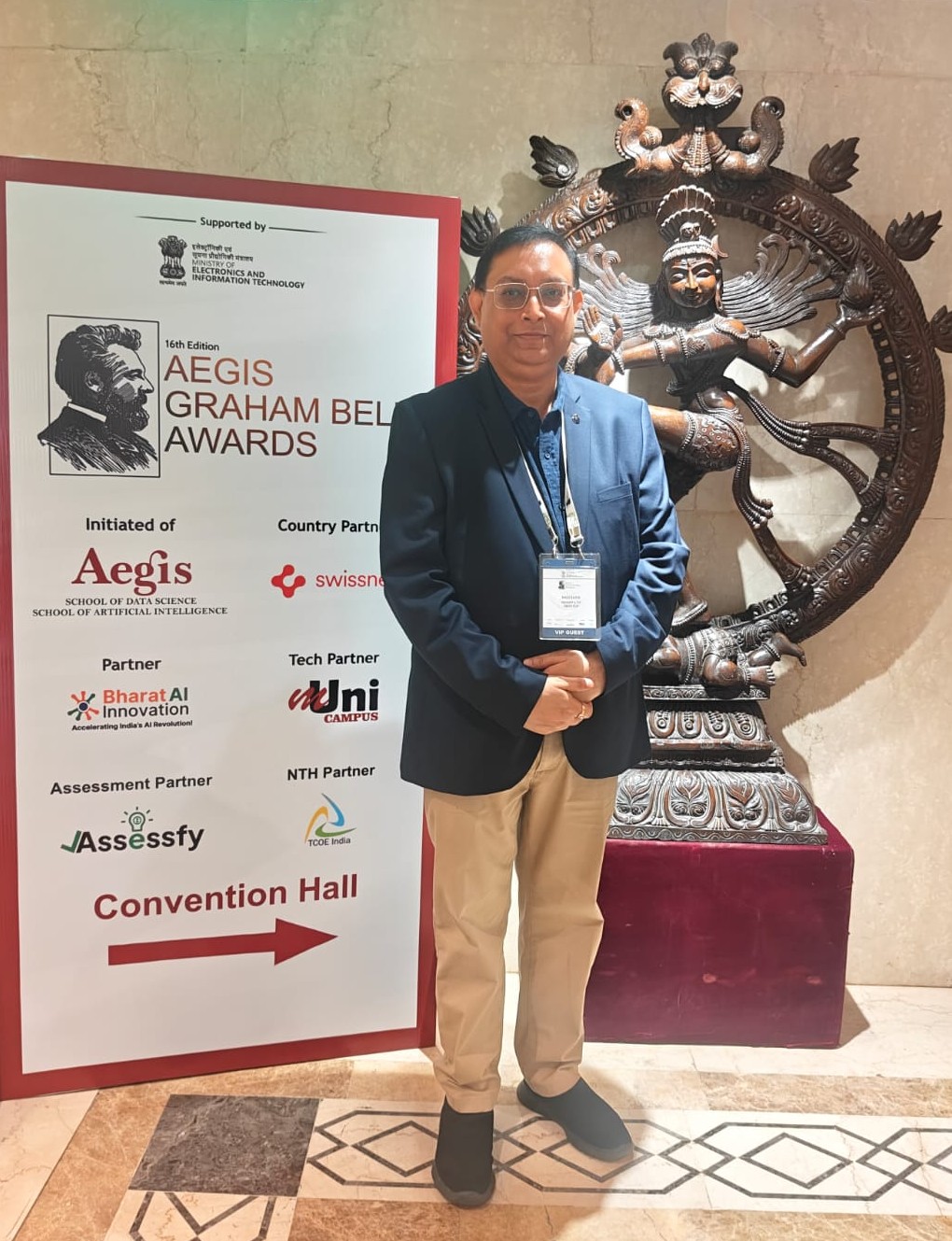
The 16th Aegis Graham Bell Awards at The Ashok, New Delhi, was not merely a talent-focused awards night. It was a clear snapshot of India’s AI maturity—where enterprise-scale execution, policy alignment, academia, and next-generation talent are converging into a single innovation ecosystem. I attended the event as one of the VIP Guests.

Keywords: Aegis Graham Bell Awards 2026, AGBA 2026, Enterprise AI India, AI innovation awards India, The Ashok New Delhi, AI talent pipeline, AI for social good

Executive takeaway: India’s AI story is moving from “pilots and proofs” to “platforms and scaled outcomes”—driven by large enterprises, supported by policy and academia, and strengthened by a deliberate talent pipeline.

Why AGBA Matters Beyond an Awards Ceremony

Many technology events celebrate innovation. Far fewer demonstrate an ecosystem in motion. AGBA stood out because it brought multiple layers of the AI value chain into one room—government, global services firms, startups, academia, and early-career innovators.

The presence of awardees and finalists from large organisations such as TCS, Cognizant, Capgemini, and Wipro is a strong signal: AI in India is being executed as a transformation lever, not as a lab experiment.

Countries lead in AI not only through models and tools, but through the depth of their ecosystem: enterprise adoption, talent supply, governance, and measurable outcomes.

Enterprise AI: From Experimentation to Institutionalisation

In boardrooms, the conversation has shifted. The question is no longer “Should we use AI?” It is increasingly “How do we redesign operating models around AI?”

What scaled AI execution typically requires

  • Data readiness: reliable data pipelines, quality, security, and observability
  • Governance: risk controls, privacy, compliance, and model oversight
  • Process redesign: re-architecting workflows rather than “automation overlays”
  • Workforce transformation: role redesign, training, and change management
  • Value measurement: clear KPIs—cost, CX, productivity, risk, and revenue impact

What was visible at AGBA is that enterprises are now competing on these capabilities—turning AI into an institutional muscle rather than a one-off initiative.

Talent Pipeline as National Infrastructure

The National Talent Hunt dimension of the evening is strategically important because it treats skills as infrastructure. Fully funded postgraduate learning in AI, data science, and business analytics, combined with a mandate to work on AI solutions for social good, creates a pipeline that is aligned to national priorities.

India’s long-term AI advantage will depend less on isolated breakthroughs and more on the sustained depth of such talent ecosystems—especially when aligned with real-world implementation needs.

AI for Social Good: From Narrative to Delivery

“AI for good” has often been discussed as intent. The stronger direction is execution. India’s scale demands AI outcomes across healthcare access, citizen services, financial inclusion, education at scale, and public infrastructure.

The important point is not that social-good projects exist, but that they are being embedded into structured learning and innovation pipelines—making impact measurable and repeatable.

The Bigger Signal: India’s AI Ecosystem Is Converging

The most meaningful observation from AGBA 2026 was the convergence of four forces that typically operate in silos:

  • Policy leadership that provides strategic direction and legitimacy
  • Large enterprises that convert innovation into scaled deployments
  • Startups & deep-tech innovators that accelerate experimentation and speed
  • Academia & young talent that sustain the long-term supply of skills and research

This convergence is how innovation becomes a durable national advantage.

Practical lens for leaders If you are building enterprise AI programs, focus on operating-model maturity: governance, data foundations, role redesign, and value measurement. That is where “AI adoption” turns into “AI advantage.”

About the author: Rinoo Rajesh works on AI-led digital transformation and enterprise operating models across large-scale programs. This post reflects a practitioner’s perspective on what AGBA 2026 signals for India’s AI decade.