Showing posts with label AIInnovation. Show all posts

Tuesday, September 08, 2026

Beyond the Algorithm: Why Leadership Will Define the Real Impact of AI

 Artificial intelligence is rapidly moving from experimentation to mainstream adoption. Across sectors, organisations are deploying AI to automate processes, analyse complex datasets, improve customer experiences, accelerate decisions and create entirely new business models. Yet, as access to sophisticated technology becomes increasingly democratised, the real competitive advantage will not come from possessing AI alone. It will come from the ability to convert its potential into responsible, scalable and measurable outcomes.

This is fundamentally a leadership and execution challenge.

Many organisations begin their AI journey by identifying tools or launching isolated pilots. While such experimentation is valuable, it does not automatically translate into enterprise-wide impact. A successful AI initiative must address a genuine business problem, align with organisational priorities, integrate with existing processes and earn the confidence of the people expected to use it. Without these foundations, even the most advanced solution can remain an impressive demonstration rather than a meaningful transformation.

This is where project leadership becomes indispensable. AI initiatives involve far more than technology implementation. They require coordination across business functions, technology teams, data owners, customers, partners and governance bodies. Leaders must define clear outcomes, establish accountability, manage uncertainty and create mechanisms through which learning from early deployments can inform subsequent decisions.

Traditional project disciplines remain highly relevant, but they must evolve for an environment in which models, data and regulatory expectations can change rapidly. Instead of treating an AI deployment as a one-time technology project, organisations must manage it as a continuing capability—one that requires monitoring, refinement and responsible oversight throughout its lifecycle.

Human judgement will therefore become more important, not less.

AI can process information at extraordinary speed, uncover patterns and recommend actions. However, it cannot independently determine which organisational values should guide a decision, what level of risk is acceptable or how an outcome may affect different stakeholders. These remain leadership responsibilities. The strongest leaders will know when to rely on technology, when to question its recommendations and when human experience, empathy and contextual understanding must prevail.

Responsible AI must also move beyond policy statements. Principles such as fairness, transparency, privacy and accountability must be embedded within project governance, solution design and operational reviews. Every material AI initiative should have a clearly identified business owner, measurable success criteria, defined escalation mechanisms and ongoing evaluation of intended and unintended consequences.

India has a remarkable opportunity to shape this next phase of transformation. Our scale, technological talent and diverse economic landscape provide a powerful environment for developing AI solutions with global relevance. Realising that opportunity will require sustained collaboration among industry, government, academia, professional communities, startups and civil society.

I look forward to contributing to this wider conversation at Bharat AI Innovation 2026 in Mumbai (https://www.linkedin.com/posts/bharat-ai-innovation_bharataiinnovation-rinoorajesh-pmipune-activity-7495359748377243648-oP0E ), where leaders and innovators will explore how AI can help create more adaptive and future-ready organisations.

The future will not belong simply to organisations that adopt AI first. It will belong to those that deploy it with clarity, discipline and purpose—using technology to strengthen human capability rather than diminish it. AI may expand what is possible, but leadership will determine what is valuable, responsible and enduring.

Monday, March 02, 2026

The Real Significance of the Aegis Graham Bell Awards: India’s AI Story Is Now an Ecosystem Play

Aegis Graham Bell Awards 2026: Enterprise AI Maturity & India’s Innovation Ecosystem

Aegis Graham Bell Awards 2026: What It Signals About Enterprise AI in India

Venue: The Ashok, New Delhi • Event: 16th Aegis Graham Bell Awards (AGBA) • Author: Rinoo Rajesh

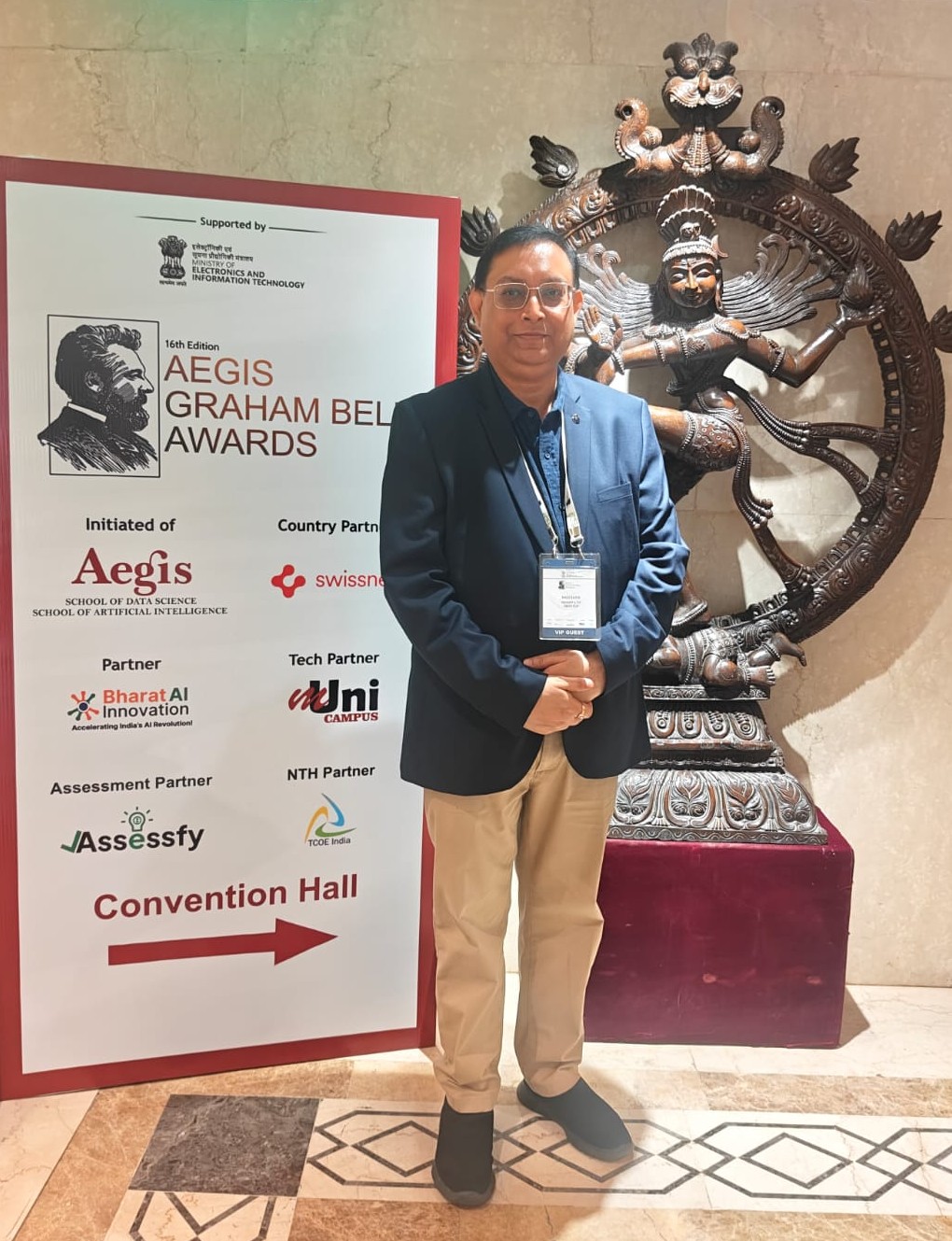
The 16th Aegis Graham Bell Awards at The Ashok, New Delhi, was not merely a talent-focused awards night. It was a clear snapshot of India’s AI maturity—where enterprise-scale execution, policy alignment, academia, and next-generation talent are converging into a single innovation ecosystem. I attended the event as one of the VIP Guests.

Keywords: Aegis Graham Bell Awards 2026, AGBA 2026, Enterprise AI India, AI innovation awards India, The Ashok New Delhi, AI talent pipeline, AI for social good

Executive takeaway: India’s AI story is moving from “pilots and proofs” to “platforms and scaled outcomes”—driven by large enterprises, supported by policy and academia, and strengthened by a deliberate talent pipeline.

Why AGBA Matters Beyond an Awards Ceremony

Many technology events celebrate innovation. Far fewer demonstrate an ecosystem in motion. AGBA stood out because it brought multiple layers of the AI value chain into one room—government, global services firms, startups, academia, and early-career innovators.

The presence of awardees and finalists from large organisations such as TCS, Cognizant, Capgemini, and Wipro is a strong signal: AI in India is being executed as a transformation lever, not as a lab experiment.

Countries lead in AI not only through models and tools, but through the depth of their ecosystem: enterprise adoption, talent supply, governance, and measurable outcomes.

Enterprise AI: From Experimentation to Institutionalisation

In boardrooms, the conversation has shifted. The question is no longer “Should we use AI?” It is increasingly “How do we redesign operating models around AI?”

What scaled AI execution typically requires

  • Data readiness: reliable data pipelines, quality, security, and observability
  • Governance: risk controls, privacy, compliance, and model oversight
  • Process redesign: re-architecting workflows rather than “automation overlays”
  • Workforce transformation: role redesign, training, and change management
  • Value measurement: clear KPIs—cost, CX, productivity, risk, and revenue impact

What was visible at AGBA is that enterprises are now competing on these capabilities—turning AI into an institutional muscle rather than a one-off initiative.

Talent Pipeline as National Infrastructure

The National Talent Hunt dimension of the evening is strategically important because it treats skills as infrastructure. Fully funded postgraduate learning in AI, data science, and business analytics, combined with a mandate to work on AI solutions for social good, creates a pipeline that is aligned to national priorities.

India’s long-term AI advantage will depend less on isolated breakthroughs and more on the sustained depth of such talent ecosystems—especially when aligned with real-world implementation needs.

AI for Social Good: From Narrative to Delivery

“AI for good” has often been discussed as intent. The stronger direction is execution. India’s scale demands AI outcomes across healthcare access, citizen services, financial inclusion, education at scale, and public infrastructure.

The important point is not that social-good projects exist, but that they are being embedded into structured learning and innovation pipelines—making impact measurable and repeatable.

The Bigger Signal: India’s AI Ecosystem Is Converging

The most meaningful observation from AGBA 2026 was the convergence of four forces that typically operate in silos:

  • Policy leadership that provides strategic direction and legitimacy
  • Large enterprises that convert innovation into scaled deployments
  • Startups & deep-tech innovators that accelerate experimentation and speed
  • Academia & young talent that sustain the long-term supply of skills and research

This convergence is how innovation becomes a durable national advantage.

Practical lens for leaders If you are building enterprise AI programs, focus on operating-model maturity: governance, data foundations, role redesign, and value measurement. That is where “AI adoption” turns into “AI advantage.”

About the author: Rinoo Rajesh works on AI-led digital transformation and enterprise operating models across large-scale programs. This post reflects a practitioner’s perspective on what AGBA 2026 signals for India’s AI decade.

Sunday, July 27, 2025

Reflections from My Episode on Industry Magnates by FaceTime with Leaders

When I was invited to be a part of Industry Magnates, a series hosted by FaceTime with Leaders, I felt both honored and humbled. It isn’t every day that one gets the opportunity to pause, look back on the professional path walked so far, and share insights that have been gathered along the way.


In our fast-paced world—where change is constant and digital transformation is more a way of life than a phase—we often don’t take enough time to reflect. This conversation gave me that space. It wasn’t about recounting titles or projects. It was about revisiting the why behind the choices, the values that have stayed constant, and the lessons that continue to evolve.

The dialogue touched upon many areas close to my heart: the changing role of leadership, the growing influence of AI and automation in the world of work, and the mindset needed to build solutions that are not only innovative but also meaningful. It was a reminder of how interconnected our roles have become—with strategy, technology, people, and purpose all blending together.

What truly impressed me was how thoughtfully the FaceTime with Leaders team has curated this platform. It’s more than a showcase—it’s a space for authentic voices to be heard, for industry professionals to share not just their successes, but also the philosophies and experiments that shaped their journeys.

As I spoke about AI-led platforms, transformation programs, and purpose-driven innovation, I couldn’t help but think of the many people and teams I’ve had the privilege of working with. Colleagues who challenged me, mentors who guided me, and peers who walked alongside me—they’ve all contributed to shaping the perspective I hold today.

A particularly meaningful part of the conversation was discussing how leadership itself is evolving. In today’s world, leadership isn’t just about direction—it’s about inspiration. It’s about being open to unlearning, encouraging collaboration, and enabling people to rise to their potential.

I am also deeply inspired by how emerging talent is reshaping the narrative. From agile innovation to social impact-driven design, the next generation of professionals brings with them a fresh lens that’s grounded in curiosity and responsibility. It’s both energizing and humbling to witness.

To the gracious hosts thank you for making this such a thoughtful and enriching experience. Your ability to draw out stories and ideas with warmth and authenticity is what makes this series special. Initiatives like these create more than content—they create connection.

To those who have reached out with kind words after watching the episode—your encouragement means more than you know. And for those who haven’t yet, I invite you to take a look at the conversation here:


🎥 Watch the episode

In closing, I don’t see this as a celebration of an individual. I see it as a tapestry of influences—of organizations that trusted, teams that collaborated, and communities that inspired. If this conversation adds value to someone just starting their journey or navigating their own transformation, I would consider that the true reward.

Let’s keep the dialogue going. Let’s continue building, leading, and learning—together.


Sunday, November 24, 2024

Embracing AI Technology: Boosting Agent Productivity and Job Satisfaction in BPOs

 In the fast-paced world of Business Process Outsourcing (BPO), where efficiency and client satisfaction are paramount, the integration of Artificial Intelligence (AI) has emerged as a game-changer. From automating mundane tasks to providing real-time insights, AI is revolutionizing the way BPOs operate. However, beyond the operational benefits, AI is also playing a crucial role in enhancing agent productivity and job satisfaction.

This article explores how embracing AI technology can transform the BPO industry by creating a more empowered and motivated workforce.


AI: The Catalyst for Productivity in BPOs

BPO agents often face repetitive and time-consuming tasks, such as data entry, call routing, and responding to FAQs. These tasks not only consume valuable time but also lead to burnout, reducing overall efficiency.

AI-powered tools like chatbots, natural language processing (NLP) engines, and robotic process automation (RPA) have emerged as solutions to these challenges. Here's how AI boosts productivity in BPOs:

  1. Automating Routine Tasks
    AI tools handle mundane and repetitive tasks, freeing agents to focus on more complex customer interactions. For example, RPA can process high-volume data with precision, minimizing errors and saving time.
  2. Improving First-Call Resolution (FCR)
    AI-driven analytics provide agents with real-time data about customer history and preferences, enabling quicker issue resolution and higher FCR rates.
  3. Smart Call Routing
    AI systems intelligently route calls based on customer needs, directing them to the best-suited agent or department, reducing call handling times.
  4. 24/7 Support
    AI-powered chatbots ensure round-the-clock assistance, reducing the load on human agents during peak hours or off-times.

Enhancing Job Satisfaction Through AI

A common misconception is that AI might replace jobs, but in reality, it complements human efforts. By taking over repetitive tasks, AI allows agents to focus on more meaningful work, fostering job satisfaction. Here's how:

  1. Reduced Burnout
    With AI handling routine inquiries, agents face fewer monotonous tasks, reducing fatigue and stress.
  2. Empowering Agents with Insights
    AI tools provide actionable insights and predictive analytics, empowering agents to make informed decisions and deliver personalized customer experiences.
  3. Training and Upskilling Opportunities
    AI-driven training modules and virtual assistants help agents acquire new skills and stay updated on best practices, boosting confidence and career growth.
  4. Recognition and Rewards
    AI systems can monitor performance metrics and identify top performers, enabling managers to recognize and reward excellence more effectively.
  5. Improved Work-Life Balance
    By optimizing workflows and reducing unnecessary workloads, AI allows agents to achieve a healthier work-life balance, increasing overall happiness.

Real-World Examples of AI in BPOs

  1. Task Automation
    Companies like UiPath and Blue Prism are leveraging RPA to automate invoice processing and other back-office operations in BPOs.
  2. Chatbots for Customer Support
    Many BPOs have integrated AI chatbots to handle tier-1 queries, significantly reducing response times and agent workloads.
  3. Sentiment Analysis
    AI-driven sentiment analysis tools help agents understand customer emotions and tailor their responses accordingly, improving customer satisfaction scores.

Challenges and Considerations

While AI brings immense benefits, its integration is not without challenges:

  • Cost of Implementation: Initial investments in AI technology can be high.
  • Resistance to Change: Employees may fear job displacement or struggle with adapting to new technologies.
  • Data Security Concerns: AI systems require access to vast amounts of data, making security a critical consideration.

To overcome these challenges, BPO leaders must adopt a transparent approach, involve agents in the AI integration process, and invest in robust data security measures.


The Road Ahead: A Human-AI Collaboration

The future of BPOs lies in a harmonious collaboration between humans and AI. By embracing AI as an enabler rather than a competitor, BPOs can unlock unparalleled efficiency, empower their agents, and deliver superior customer experiences.

As BPOs continue to evolve, AI will remain at the forefront, not just as a technological advancement but as a tool to redefine workplace satisfaction and productivity.