Showing posts with label leadership. Show all posts

Sunday, April 05, 2026

Honored to Receive the AI Leadership Award at AI Arena 2026: Reflections on Building AI Systems That Matter

Honored to Receive the AI Leadership Award at AI Arena 2026: Reflections on Building AI Systems That Matter

Receiving the “AI Leadership Award” at AI Arena – AI Summit 2026, hosted by Indira University, Pune, was both humbling and energizing. Awards are always special, but some recognitions carry a deeper meaning because they validate not just a moment, but a long journey of experimentation, persistence, learning, building, and transformation. This recognition meant a great deal to me because it was not simply about speaking at an event or being part of a panel. It was about the larger body of work that has gone into shaping, building, deploying, and evangelizing AI-enabled systems across multiple industry contexts.

I am deeply grateful to Indira University, to the ever-observant and encouraging Dr. R. L. Bhatia, and to Mr. Aasif Sayed for their gracious support and warm recognition. Moments like these invite not only gratitude, but also reflection. They force one to pause and ask: What exactly has this journey stood for? What has been built? What has been learned? And where does the road ahead lead?

The Meaning of the Recognition

For me, this award is not merely a ceremonial milestone. It represents recognition of a practical and execution-oriented approach to Artificial Intelligence in the enterprise. In recent years, AI has captured global imagination at an unprecedented scale. But between excitement and enterprise value, there is often a large gap. Many organizations are still trying to move from fascination to outcomes, from pilots to platforms, from experimentation to measurable business value.

My own work has consistently focused on bridging this gap.

That has meant moving beyond broad conversations about AI and instead working on how AI can be designed into the real operating fabric of organizations. It has meant thinking about AI not just as a technology capability, but as a layer that can improve decision-making, customer experience, operational efficiency, business agility, and enterprise adaptability.

Over time, this has translated into the building and deployment of more than 10 AI-enabled platforms and over 100 prototypes spanning conversational AI, customer experience systems, workflow augmentation, analytics support, enterprise knowledge enablement, debt collections transformation, marketing and CRM enhancement, and several back-office use cases.

That is the context in which this award becomes meaningful. It is a recognition not of theory alone, but of an enduring belief: AI must move from buzzword to business architecture.

From AI Experiments to AI-Enabled Enterprise Systems

One of the most important lessons from my AI journey is that organizations do not derive value merely by acquiring AI tools. They derive value when they embed intelligence into workflows, redesign decision loops, and enable teams to act faster and better.

Across the systems and platforms I have helped shape, one recurring principle has been this: AI works best when it is contextual, operational, and outcome-linked.

In practical terms, this has included work on:

  • Conversational AI systems for customer and employee interaction
  • AI-assisted agent support to improve guidance, compliance, and productivity
  • AI-enabled CRM and workflow intelligence to support better lead, service, and engagement processes
  • Back-office AI applications that reduce manual effort and improve process visibility
  • Collections and recovery intelligence to improve prioritization, segmentation, and actionability
  • Enterprise knowledge and decision support systems that help teams access the right information at the right time

What has been particularly fulfilling is seeing how AI, when used thoughtfully, can impact both front-end customer experiences and deep operational layers. This duality is important. Too often, AI is treated either as a flashy engagement technology or as a purely technical backend layer. In reality, the strongest enterprise outcomes emerge when AI spans both worlds: human interaction and operational intelligence.

Why Practical AI Matters More Than Ever

We live in an era defined by volatility, uncertainty, complexity, and ambiguity. In such a world, the value of AI is not limited to automation. Its true value lies in its ability to help organizations frame challenges faster, test responses intelligently, surface patterns earlier, and build adaptive capabilities that evolve with disruption.

This is why I increasingly see AI as an enterprise resilience engine.

In stable environments, organizations can afford to optimize slowly. In unstable environments, they need to sense, interpret, and respond continuously. That is where AI becomes strategically relevant. It can improve the speed at which organizations move from information to insight, from insight to action, and from action to learning.

In my own work, I have seen how AI can help teams:

  • Reduce decision latency
  • Improve consistency in execution
  • Accelerate access to knowledge
  • Enhance customer and agent experiences
  • Identify priority patterns in operational data
  • Create more adaptive and scalable digital processes

This is especially important in environments where scale, complexity, compliance, and customer expectations intersect. AI is no longer just about doing things faster. Increasingly, it is about deciding things better.

Building Across Customer Experience and Back-Office Intelligence

One of the defining aspects of my AI journey has been the breadth of business contexts in which AI has been applied. I have always believed that enterprise AI should not be confined to a single silo. It must travel across the value chain.

On one side, there is the world of customer experience: conversations, service, support, response quality, omnichannel interactions, personalization, knowledge guidance, and real-time decision support. Here, AI has immense value in augmenting human teams, accelerating response quality, and making interactions more intelligent and context aware.

On the other side, there is the domain of back-office and process intelligence: workflows, operations, analytics, support functions, follow-up systems, monitoring, escalation logic, and productivity enhancement. Here too, AI can act as a force multiplier by reducing manual burden, improving pattern recognition, and helping organizations move from reactive to more predictive and proactive operating models.

What excites me most is the convergence of these two worlds. The future of enterprise AI lies not in isolated AI deployments, but in linked ecosystems where conversational systems, operational systems, knowledge systems, and analytics systems work together.

This is where the enterprise starts moving from automation toward AI-augmented orchestration.

Beyond Deployment: The Importance of Thought Leadership

While building and deploying AI systems has been a major part of my journey, another equally important dimension has been writing and thought leadership.

As an author, I have written extensively on themes such as Generative AI, Agentic AI, enterprise transformation, and the future of intelligent systems. Writing has been my way of not only documenting change, but also helping leaders and practitioners understand where AI is headed and how they should respond.

I have always felt that in a field moving as fast as AI, practical clarity is as important as technical sophistication. Many business leaders are not looking for algorithms; they are looking for guidance. They want to understand what is hype, what is real, what is scalable, what is responsible, and what is worth betting on.

My books and articles have therefore tried to address a simple but important challenge: How can we make AI understandable, strategic, and actionable for leaders, builders, and institutions?

This is also why recognitions like the AI Leadership Award feel especially satisfying. They acknowledge both dimensions of the journey: the builder’s journey and the thinker’s journey.

What Enterprise Leaders Need to Understand About AI Today

If I were to summarize the current moment in enterprise AI, I would say this: we are moving from AI as a tool to AI as an operating layer.

This is a profound shift.

Earlier, organizations saw AI as something to experiment with at the edges. Today, the conversation is increasingly about embedding AI into core business functions, governance frameworks, knowledge systems, customer journeys, and execution models.

For leaders, this raises a new set of questions:

  • How do we prioritize the right AI use cases?
  • How do we connect AI with enterprise data and workflows?
  • How do we balance innovation with governance?
  • How do we create human-AI collaboration rather than anxiety?
  • How do we ensure that AI produces real business value and not just experimentation theater?

These are not engineering questions alone. They are management and leadership questions. This is why I believe the next phase of AI success will be determined not only by data scientists and developers, but by leaders who can redesign organizations for an AI-first future.

AI, Adaptability, and the VUCA World

The term VUCA has been with us for years, but AI gives it a new operational meaning. In a VUCA world, the organizations that survive and grow are not necessarily the biggest or the most resource-rich. They are the most adaptive.

Adaptability, however, is not an abstract trait. It is built through systems that can sense, learn, guide, and evolve. This is where AI has become deeply relevant.

Artificial Intelligence enables organizations to:

  • Frame problems earlier by recognizing patterns in data and interactions
  • Prototype responses faster through simulation, automation, and augmented intelligence
  • Improve execution quality by guiding users, reducing inconsistency, and surfacing recommendations
  • Build learning loops where systems improve based on exceptions, outcomes, and feedback

In other words, AI is not merely a productivity enabler. It is becoming a strategic mechanism for organizational adaptability.

This is one of the strongest convictions I carry forward from my work: AI is not just about efficiency; it is about resilience, responsiveness, and renewal.

The Responsibility That Comes With Recognition

Recognition is gratifying, but it also brings responsibility.

When one is acknowledged for leadership in AI, the obligation is not merely to continue building. It is to help shape a healthier, more grounded, and more responsible conversation around the future of AI.

That means championing AI that is:

  • Practical rather than performative
  • Responsible rather than reckless
  • Contextual rather than generic
  • Scalable rather than one-off
  • Human-augmenting rather than human-alienating

The AI discourse often swings between two extremes: utopian optimism and dystopian fear. In reality, the enterprise path lies in disciplined execution. Organizations must ask not just what AI can do, but what it should do, where it should be applied, how it should be governed, and who should remain accountable.

This is where leadership matters most.

My Continuing Commitment

As I reflect on receiving the AI Leadership Award, I do so with gratitude, but also with renewed commitment.

The work is far from done.

There is still enormous scope to build AI systems that create more meaningful impact across industries. There is still a need to simplify AI for boards, CXOs, managers, students, and practitioners. There is still a need to convert prototypes into platforms, ideas into operating models, and intelligence into enterprise value.

I remain committed to continuing this journey across three interconnected dimensions:

  1. Building practical AI-enabled systems that solve real problems
  2. Writing and sharing structured thought leadership on where AI is going
  3. Enabling leaders, teams, and institutions to think more strategically about AI adoption and transformation

If there is one message I would leave with fellow leaders and builders, it is this:

The future will not belong to organizations that merely adopt AI. It will belong to those that redesign themselves intelligently around it.

Gratitude and Looking Ahead

My heartfelt thanks once again to Indira University, Dr. R. L. Bhatia, and Mr. Aasif Sayed for this honor and encouragement.

I accept this recognition not as a culmination, but as a marker on a longer journey—a journey of exploring how AI can move from possibility to performance, from innovation to impact, and from systems of automation to systems of intelligent transformation.

The next chapter of AI will not be written by technology alone. It will be written by those who can combine vision, architecture, execution, ethics, and continuous learning.

I look forward to continuing to build, contribute, write, and collaborate in that spirit.

Grateful for the recognition. Committed to scaling the work further.

Sunday, February 22, 2026

Industry–Academia Collaboration in the Age of AI: Honoured at Confab 360°

Industry–Academia Collaboration in the Age of AI: Honoured at Confab 360° Global Conference

By Rinoo Rajesh • 6–8 min read
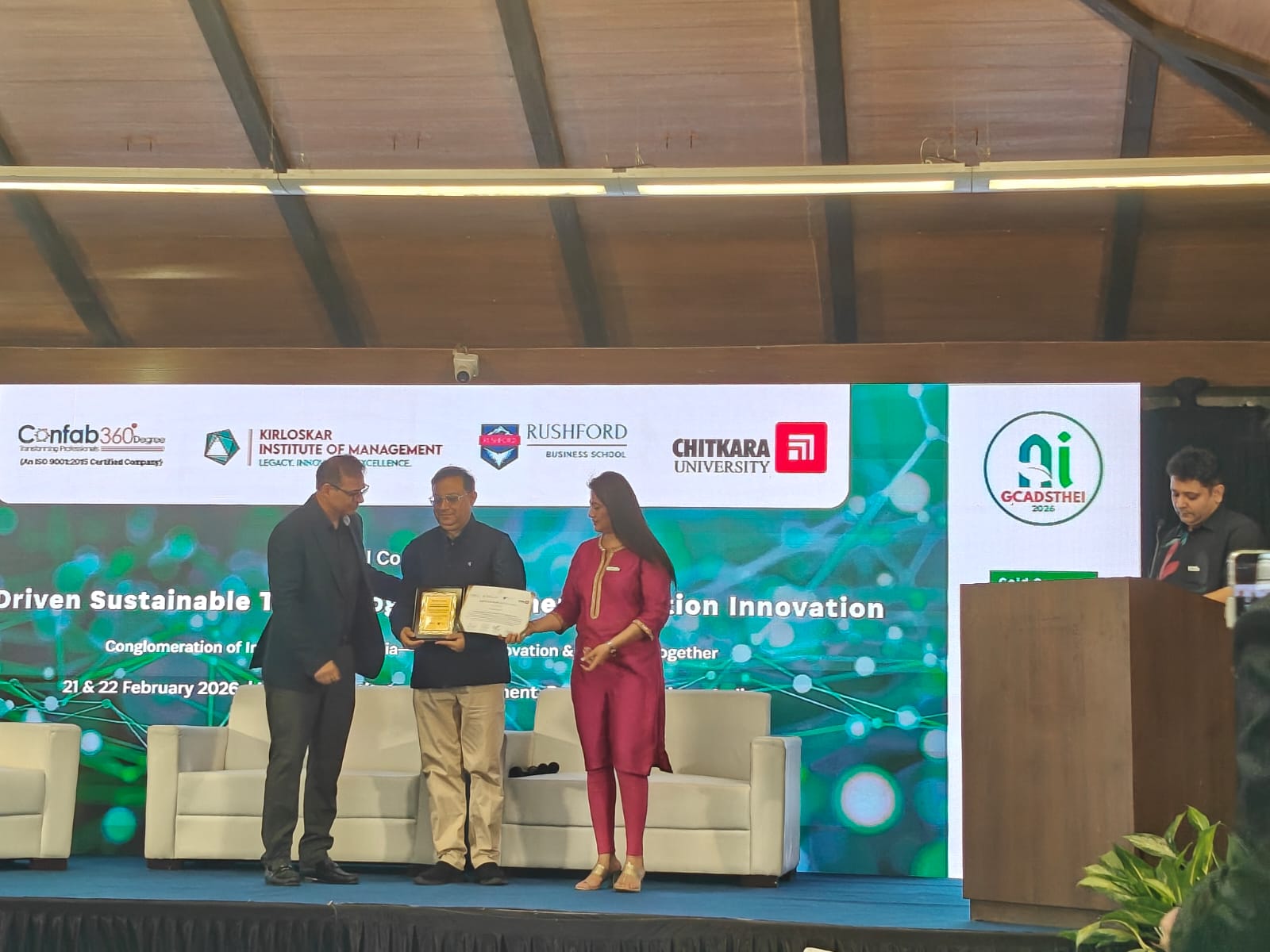
Rinoo Rajesh receiving Industry–Academia Integrator Award for AI & Education Synergy at Confab 360 Global Conference
Receiving the Industry–Academia Integrator Award for AI & Education Synergy at the Confab 360° Global Conference.

Today, I had the honour of being recognised at the Confab 360° Global Conference with the Industry–Academia Integrator Award for AI & Education Synergy. I am grateful for this acknowledgement— not because awards are the destination, but because they represent a growing, shared conviction: the future of talent and innovation will be shaped by how effectively industry and academia work together.

Confab 360° is building exactly that kind of bridge—bringing together thought leaders, educators, innovators, and practitioners to create meaningful dialogue on business, technology, leadership, and impact. Events like these are not mere gatherings; they are catalysts for collaboration, knowledge exchange, and collective growth.

In the age of AI, the most valuable advantage is not technology alone—
it is the ecosystem that converts technology into skills, skills into outcomes, and outcomes into societal progress.

If you’d like context on my larger perspective on this theme, you can also read: Bridging Industry and Academia in the Age of AI .

Why Industry–Academia Collaboration Matters More Than Ever

AI is compressing time. Roles are evolving faster than traditional curriculum cycles, and organisations are under pressure to modernise capability—without compromising quality, compliance, or ethics. In this environment, industry–academia collaboration becomes a strategic necessity—not a goodwill initiative.

1) Building AI-Ready, Future-Ready Talent

The employability gap is rarely about intelligence or intent. It is often about exposure: real problem statements, modern tooling, cross-functional thinking, and professional communication. When academia and industry co-design learning journeys, students graduate with:

  • Role clarity: what the job actually looks like in real settings
  • Skill relevance: the right balance of fundamentals + applied capability
  • Portfolio credibility: projects that are measurable and verifiable
  • Professional maturity: communication, stakeholder thinking, and ownership

2) Translating Research Into Real-World Outcomes

Research becomes powerful when it solves a lived problem—whether in banking, healthcare, manufacturing, education, or public services. With AI, applied research can move from theory to prototype to deployment faster than ever—if we align: problem owners (industry), research capability (academia), and delivery discipline (execution teams).

3) Creating Responsible AI Through Governance and Practice

Responsible AI is not a slide—it is an operating model. When academia and industry collaborate, we can embed best practices around: privacy, security, bias checks, human-in-the-loop review, auditability, and change management—so AI adoption becomes sustainable.

What “AI & Education Synergy” Looks Like in Practice

“Synergy” can sound abstract, so here are practical ways this shows up when done well:

  • Curriculum modernization with industry review boards and fast refresh cycles
  • Live projects with real constraints: timelines, compliance, stakeholder feedback
  • Faculty enablement via industry immersion and co-teaching models
  • Innovation labs where prototypes are tested with real users and data boundaries
  • Mentorship networks that build both technical and leadership capability
  • Career readiness programs that focus on role-based outcomes, not generic training

Reflections From Confab 360°: Ecosystems Create Momentum

One of the most inspiring aspects of Confab 360° is the intent to build a platform that brings diverse stakeholders together— educators, researchers, industry leaders, and policy influencers—to build momentum around innovation and higher education. The energy and clarity of purpose across the community reinforced a simple insight:

Collaboration works when it is designed—with outcomes, cadence, roles, and accountability.

Acknowledgements and Gratitude

I extend heartfelt thanks to Confab 360° and the institutions and leaders who made this conference meaningful. I am grateful for the recognition and, more importantly, for the opportunity to keep contributing to a cause that matters.

If you are a university, institute, corporate, or industry body looking to strengthen your industry–academia bridge (AI readiness, applied projects, innovation labs, curriculum review, mentorship ecosystems), I’m open to structured collaboration conversations.

You can reach me via my blog or connect on LinkedIn (https://www.linkedin.com/in/rinoorajesh) or (https://www.rinoorajesh.com)

Monday, January 26, 2026

Republic Day Reflections: Leadership, Technology, and the Responsibility of Scale

On this Republic Day of India, I find myself reflecting on a simple but powerful idea:

the true strength of our Republic lies not merely in the words of our Constitution, but in our collective intent—to innovate responsibly, lead ethically, and create impact at scale.


India’s journey over the past decades has been extraordinary. From a young democracy finding its footing, we have evolved into a nation confident of its voice, its capabilities, and its place in the global order. Today, that confidence is increasingly powered by technology, talent, and entrepreneurial ambition.

Yet, with scale comes responsibility.

India at an Inflection Point

We stand at the cusp of an AI-led and digitally empowered future. Technologies that were once experimental are now foundational. Artificial intelligence, data platforms, automation, and digital ecosystems are no longer optional—they are shaping how governments govern, how enterprises compete, and how citizens engage with the world.

This moment represents an inflection point.

Technology can be a great equalizer—or a great divider.
It can amplify trust—or erode it.
It can empower talent—or marginalize it.

The outcomes are not determined by the tools themselves, but by the choices we make as leaders, technologists, and entrepreneurs.

The Leadership Imperative in a Digital Republic

Leadership in today’s India demands more than execution excellence. It calls for judgement, foresight, and ethical clarity.

As decision-makers, we must ask:

  • Are we building systems that uplift society, not just optimize efficiency?
  • Are we designing platforms that empower human potential, not replace it thoughtlessly?
  • Are we deploying technology in ways that strengthen trust—with customers, citizens, employees, and institutions?

In a Republic founded on democratic values, leadership must always remain accountable to people, not just performance metrics.

Responsible Innovation as a National Strength

Innovation has always been part of India’s DNA—from frugal engineering to world-class digital public infrastructure. What distinguishes the next phase of India’s growth is the opportunity to lead with responsible innovation.

Responsible innovation means:

  • Embedding ethics and transparency into AI and data-driven systems
  • Designing with inclusion and accessibility in mind
  • Ensuring technology serves long-term societal outcomes, not just short-term gains

When innovation is anchored in values, it becomes a force multiplier—enhancing both economic competitiveness and social cohesion.

Building for Scale, Without Losing the Human Core

India’s scale is unmatched—of population, aspiration, and complexity. As we build platforms, enterprises, and ecosystems at scale, it is vital that we do not lose sight of the human core.

Technology should:

  • Enable individuals to learn, grow, and participate meaningfully
  • Help organizations become more resilient and adaptive
  • Support institutions in delivering services with dignity and trust

Progress that leaves people behind is not progress.
Growth that erodes trust is not sustainable.

A Recommitment to the Spirit of the Republic

Republic Day is not just a celebration of the past; it is a renewal of intent for the future.

Let us recommit ourselves to building an India that is:

  • Inclusive in opportunity
  • Intelligent in its use of technology
  • Values-driven in leadership and governance

An India where innovation and integrity go hand in hand.
An India that leads not only in scale, but in principle.

That, to me, is the true spirit of our Republic.

Jai Hind

Sunday, December 14, 2025

Leadership Conversations Beyond the Boardroom: An Evening at the GCC Leaders Golf Mixer

I recently had the opportunity to attend the GCC Leaders Golf Mixer in Pune, hosted at the iconic Poona Club Golf Course, and it turned out to be one of the most refreshing leadership and networking experiences I’ve had in recent times.


What made this gathering stand out was its intentional simplicity — no presentations, no pitches, no fixed agendas. In an era where leadership forums are often dominated by presentations, pitches, and rigid agendas, this gathering stood apart. There were no slide decks, no sales conversations, and no predefined outcomes — just meaningful networking and open conversations among leaders from Global Capability Centers (GCCs), finance, and technology.

Just leaders from GCCs, finance, and technology coming together in a relaxed, open setting to exchange perspectives, experiences, and ideas. In a world overflowing with structured meetings and slide decks, this format felt like a welcome pause — one that allowed conversations to flow naturally and authentically.

Golf and Leadership: Lessons Beyond the Game

The choice of golf as the medium for engagement was particularly thoughtful. The game itself encourages calm, focus, and introspection — qualities that mirror many aspects of leadership and transformation work.

As someone still discovering the sport, the experience was both enjoyable and humbling. Golf has a way of reminding you that progress comes from patience, precision, and continuous learning — lessons that translate seamlessly into how we lead teams, drive change, and navigate complexity in professional environments.

Every swing, much like every leadership decision, demands intent, awareness, and acceptance that improvement is a journey rather than an instant outcome.

The Power of Unstructured Peer Exchange

What I valued most was the quality of peer-to-peer conversations. Without the pressure of formal agendas or outcomes, discussions became deeper, more honest, and far more insightful.

What truly elevated the evening was the quality of peer-to-peer networking. Conversations flowed effortlessly across topics such as:

  • GCC leadership challenges
  • Digital and organizational transformation
  • Talent, culture, and capability building
  • Navigating scale and complexity

Without the pressure to sell or impress, discussions became deeper, more candid, and far more valuable. These are the interactions that often lead to long-term professional relationships and collaborative opportunities.

These are the kinds of interactions that often spark long-term connections — not because of what was sold or presented, but because of what was genuinely shared.

Gratitude and Looking Ahead

My sincere thanks to the Bluecopa team for curating such a thoughtful and well-designed platform for leadership networking. I look forward to staying connected with the inspiring leaders I met and continuing these conversations beyond the event. Equally, I’m excited to continue my journey as a budding golfer, learning one swing — and one leadership lesson — at a time.

In a fast-changing world, it’s often these informal, well-designed interactions that leave the most lasting impact on how we lead, connect, and transform.

 And yes, I’m equally looking forward to continuing my journey as a budding golfer, learning one swing (and one leadership lesson) at a time.

Monday, October 20, 2025

🌏✨ Lighting the Future: Diwali in the Age of Intelligence

Every Diwali, as millions of lamps shimmer across homes and hearts, I am reminded that light has always been more than an ancient metaphor — it is humanity’s oldest declaration of hope. The story of Diwali may have begun centuries ago, but its essence — the triumph of knowledge over ignorance, purpose over passivity, and harmony over chaos — feels more urgent than ever in our world today.

🔥 Beyond Celebration — Towards Conscious Illumination

We live in an age of algorithms and accelerated change, where intelligence—both human and artificial—is redefining what progress truly means. Yet Diwali reminds us that no matter how advanced our technologies become, the true illumination must always begin within.

Lighting a lamp is symbolic — a gesture of clarity amidst complexity. In boardrooms, classrooms, communities, and even in code — the “light” we seek is empathy, wisdom, and responsibility. The power to shape the future is not just in the machines we build, but in the values we embed within them.

💡 Innovation with Integrity

In my professional journey across digital transformation and AI, I’ve seen how technology can magnify both intention and impact. It can either create inclusion — or deepen divides. Diwali urges us to choose the former: to use innovation not as a weapon of efficiency alone, but as a torch of equity — illuminating access, amplifying human dignity, and ensuring that progress never leaves anyone behind.

The future we’re building — through Generative AI, automation, or connected ecosystems — must reflect the same principles Diwali celebrates: illumination without arrogance, intelligence with humility, and power tempered by compassion.

🌱 A Call for Sustainable Prosperity

Diwali also marks a time of abundance and renewal. But in a world facing climate crisis and inequality, prosperity can no longer be measured merely by wealth or consumption. It must be redefined as well-being, inclusivity, and sustainability.

Imagine if every diya we light this year represents a conscious commitment — to reduce waste, mentor one more individual, adopt cleaner practices, or support a small artisan whose craft keeps our heritage alive. That would be a true celebration of light — where every glow gives back.

🌠 The Light Within Leadership

Leadership today demands the courage to illuminate paths that don’t yet exist. To question comfort zones, bridge disciplines, and ignite collective purpose. Whether leading a team, a company, or a community — the challenge is to be a source of light, not just a seeker of it.


In that sense, Diwali is not just a festival — it is a leadership philosophy. It teaches us that light shared is never light diminished.

As we enter another year of opportunities and challenges, may we all light not just our homes, but our habits. May we build technologies that respect humanity, economies that reward empathy, and societies that celebrate diversity.

Let’s make Diwali not a moment, but a movement — from darkness to data, from data to wisdom, and from wisdom to oneness.

Happy Diwali to all — may your light shine brighter than ever.

Saturday, January 07, 2023

Seeing the world through the eyes of others

Seeing the world through the eyes of others:

Most organizations create an ineffective system of rules and policies that attempt to prepare for every possible contingency. The thing about rules and policies is they become very hard to fix once they are put in place. Both the people who put them in place and those whose job it is to exercise them become highly motivated advocates of the policies. Even if the policies originally made sense, they become very hard to change as the environment changes. When you try to change something but can’t, you start becoming a tenant and stop being an owner. And ownership dramatically increases the odds of success. We should focus on:

1.       Empathy: Seeing the world through the eyes of others helps us to develop empathy and understanding for people who may have different perspectives and experiences than us.

2.       Perspective: Seeing the world through the eyes of others gives us a different perspective on life and helps us to appreciate different cultures and beliefs.

3.       Compassion: Seeing the world through the eyes of others helps us to cultivate compassion and understanding for those who may be different than us.

4.       Respect: Seeing the world through the eyes of others helps us to respect and appreciate the diversity of the human experience.

5.       Growth: Seeing the world through the eyes of others helps us to grow and expand our own worldview, allowing us to become more open-minded and accepting of others


#job #success #people #change #environment #changesforthebetter #leadership #talent